August 21, 2026


Have you ever found yourself reacting emotionally before you even realized what was happening?
While our responses to emotions can feel sudden and unpredictable, they actually follow a simple three step process. Every emotional experience unfolds through a sequence of events shaped by our current circumstances, and our past experiences. Understanding the Emotional Episode Timeline can help us recognize our emotions earlier, respond more skillfully, and over time, soften patterns that no longer serve us.
At its simplest, an emotion flows like this:
Trigger → Experience → Response
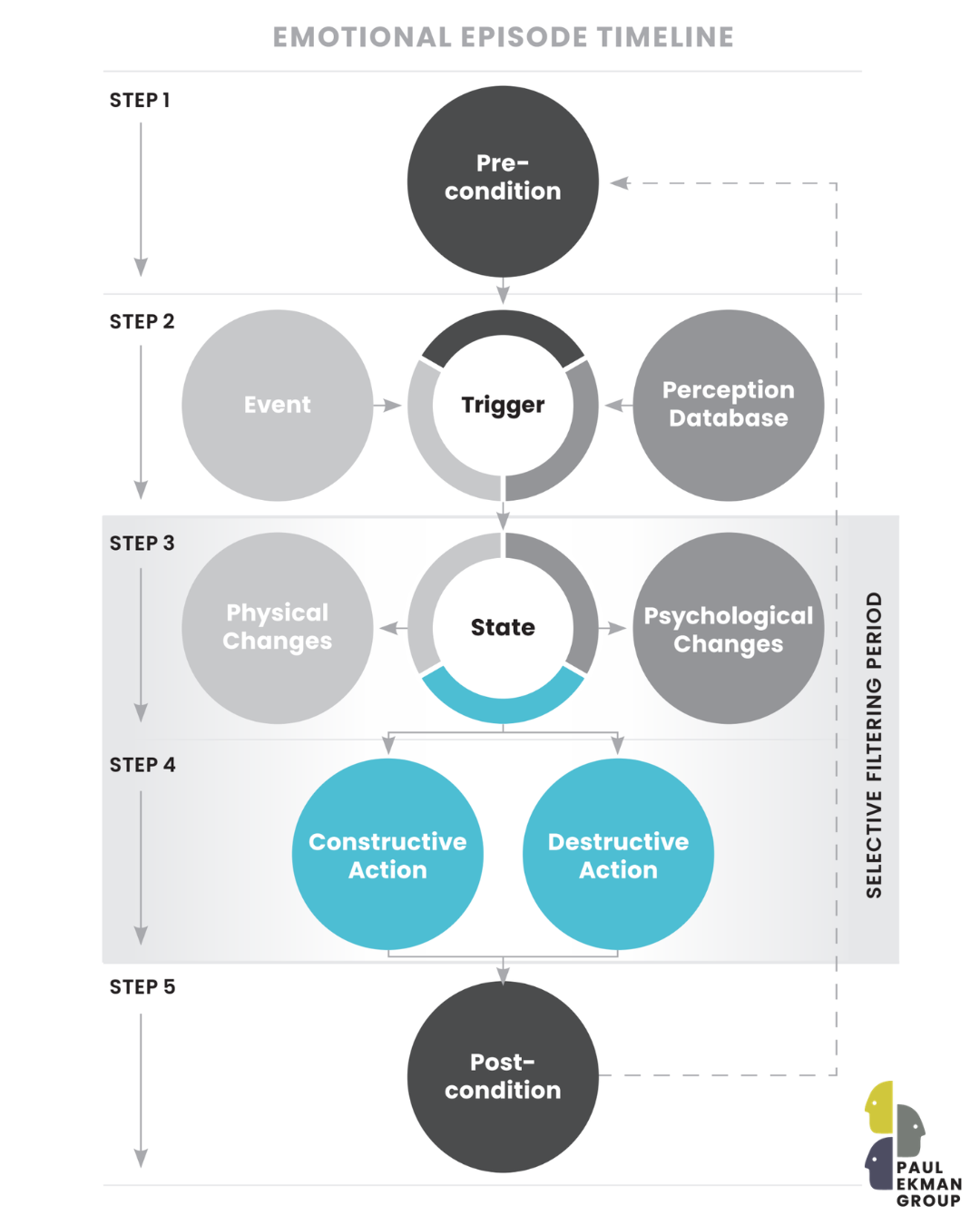
That basic sequence happens countless times throughout each day. We may not recall the majority of the small episodes, like being frustrated about not being able to find our keys, or phone. Even small episodes carry interesting information about habits and patterns we may not be aware of- like wanting to blame someone for moving our keys or being too hard on ourselves. To further illuminate the habits and patterns underneath the 3 step process, the Emotional Episode Timeline breaks it down into 5 steps.
Stages of Emotion
Our pre-condition is the physical and emotional context we bring into the moment, kind of like our “emotional starting point”.
Maybe we’re tired after a poor night’s sleep, hungry, stressed from work, excited after receiving good news, or simply calm and well-rested. Our pre-condition can set the stage for how easily an emotion may arise. Sometimes there’s very little pre-condition if we’re feeling neutral or at ease.
The trigger arises from a combination of events, our appraisals of them, and our internal “database” (along with our pre-condition in the moment).
An event is something we encounter externally or internally. It could be a: person, place, situation, thought/memory/fantasy, or through any of our sense portals: sight, smell, sound, taste, touch.
Our mind is constantly monitoring and quickly, unconsciously evaluating what’s happening in and around us, checking for potential opportunity or harm, and preparing us for action. This process is called automatic appraisal. For example, we suddenly swerve the car to avoid hitting a dog running in the road, or we perceive rejection after not receiving a return text from a new friend.
Every one of us carries a unique perception database: an internal library of emotional memories and built-in responses that shapes how we interpret the world around us. You can think of it as an “emotional alert system” that helps our mind quickly determine whether something is significant.
This database draws from two sources:
This is the emotion itself— the “Experience” step from the simple version above — a full mind-body experience combining both physical and psychological shifts.
This encompasses how the body responds when we are experiencing emotion. Depending on the emotion, we may notice things like our heart beating faster, heat rising in the face, tightness in the jaw, butterflies in the stomach, tears forming, muscles tensing, or changes in breathing.
Research suggests that each universal emotion is associated with its own characteristic pattern of physiological changes that prepare us for action. Sometimes we are not aware of our trigger but we become aware of the sensations in the body changing.
This is how the emotion feels from the inside, our subjective “felt sense”. For example, sadness may feel heavy and slow; anger may feel hot and sharp. Each emotion has its own flavor, its own way of coloring psychological experience.
Emotions move us to act. Sometimes the response is external (i.e. yelling in anger, reaching out in joy). Other times it’s internal (i.e. suppressing anger, softening into compassion). Rather than categorizing emotions as “positive” or “negative”, it’s more useful to ask whether our responding actions are:
For example, while many people think of anger as being “negative” due to the potential of associated destructive actions, constructive anger can be helpful to ourselves and others.
Every emotion leaves an impact. If we yelled in anger, the other person may yell back. If we suppressed our anger, irritation may linger inside. These post-conditions can spark the next emotional episode (i.e. becoming angry again, fearing someone’s response, regretting our behavior) setting the cycle in motion again. But they also offer an important opportunity: to pause, reflect, and learn from what just happened.
This isn’t a sixth step — it’s something that happens during Steps 3 and 4 above:
During steps 3 and 4 we are subject to a selective filtering period. When an emotion is active, our perception narrows. We filter information to fit the prevailing emotion. In fear, for instance, we become hyper-focused on threats, both real and imagined. The same thing happens in anger, where we tend to notice only what’s frustrating and tune out anything that’s going fine. This filtering helps us survive but can also distort reality if we aren’t aware of it.
If you’d like to explore these ideas in more depth, The Feelings Field Guide includes the Emotional Episode Timeline in its companion guidebook, along with other emotion science fundamentals, practical exercises, and activities for building emotional awareness.
The Emotional Episode Timeline is also one of the concepts included in the Atlas of Emotions, the free interactive tool created by Drs. Paul and Eve Ekman to help people better understand how emotions arise, unfold, and influence our actions.
We’re excited to share that Dr. Eve Ekman is currently developing the Atlas of Emotions book, which will expand on the concepts from the online Atlas with additional insights, illustrations, and practical guidance. Join our notification list below to be among the first to hear when it’s available.
Why do I react before I even know what’s happening? Automatic appraisal happens unconsciously, as part of the trigger stage — your brain evaluates for potential help or harm before your conscious awareness catches up.
Why do small things set me off more on some days than others? Your pre-condition — how tired, stressed, hungry, or calm you already are — shapes how easily an emotion arises in the first place.
Why can’t I think clearly when I’m upset? During the state and action stages, you enter a selective filtering period, where your perception narrows around the emotion you’re feeling.
Can I control how I react to an emotion? The trigger and state stages are largely automatic, but the action stage — how you choose to respond — is where constructive choices become possible.
August 21, 2026
June 8, 2026