August 21, 2026


Comparing Mood, Emotion, and Attitude
Building on our previous exploration of the differences between moods and emotions, we’re expanding the conversation to include a third important concept: attitudes.
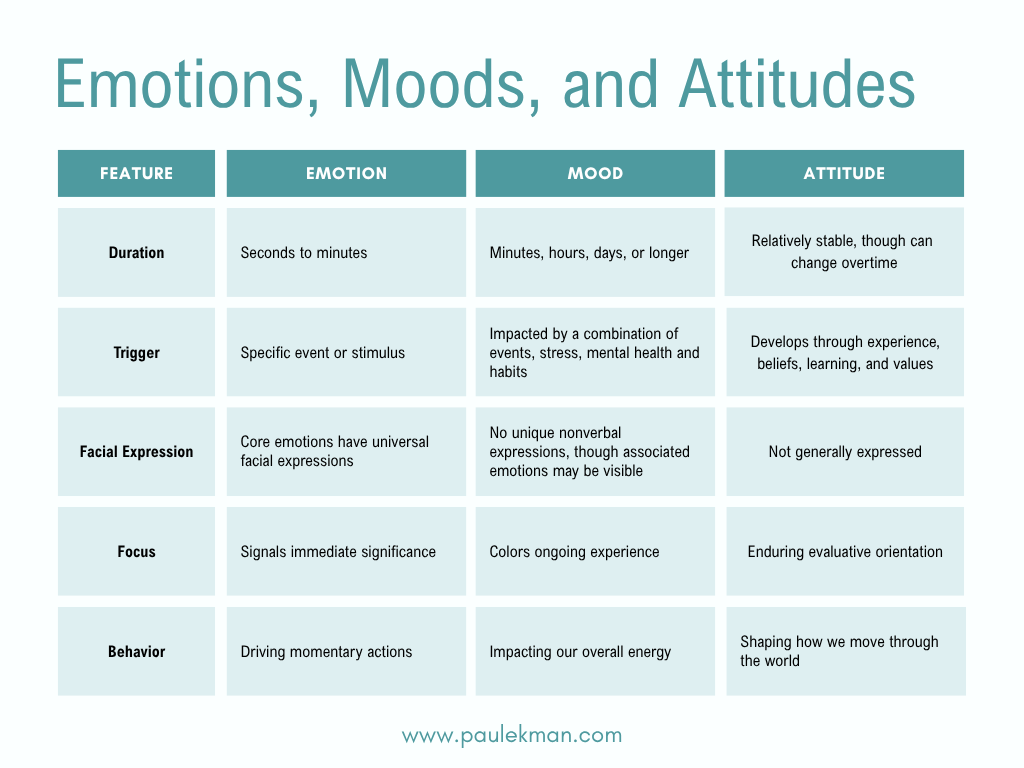
Emotions, moods, and attitudes all shape how we experience ourselves and the world around us, but they operate on different timescales and serve different psychological functions. Understanding how they interact can deepen emotional awareness, improve emotional regulation, and help us better understand our patterns of thinking and behavior.
Emotions are an automatic appraisal process influenced by both our evolutionary history and personal experiences. They arise when something significant happens in relation to our goals, needs, or well-being, setting into motion coordinated psychological and physiological changes.
By definition, emotions are relatively brief, often lasting from fractions of a second to minutes. They involve changes throughout the body, including physiology and facial expression, preparing us to respond to what matters most in the moment.
In contrast, moods linger. Moods are more diffuse affective states that can last for hours, days, or even longer. Unlike emotions, they often lack a clearly identifiable trigger and are not directed toward a specific event or object. We can wake up in a mood, or we can find ourselves slipping into one without any clear reason why.
Moods also tend not to produce the distinct facial expressions associated with many emotions, though subtle signs such as muscle tension, posture, or changes in energy may be noticeable.
Rather than responding to one particular situation, moods can create more of an emotional backdrop. They can influence how easily certain emotions are triggered and can shape how we interpret events, social interactions, and even our own thoughts throughout the day.
Unlike emotions or moods, attitudes are not emotional states themselves. Instead, attitudes are relatively enduring evaluations of people, ideas, objects, behaviors, or experiences. Psychologists often describe attitudes as involving a combination of beliefs, emotional associations, and behavioral tendencies. A popular framework for understanding the three components of attitude is the ABC model:
Attitudes are also often categorized as explicit (something we are consciously aware of) or implicit (something we are unconscious of, but still impacts us).
An attitude toward public speaking, for example, may include beliefs (“It’s an important skill”), emotional memories (“I felt embarrassed giving a presentation”), and our behaviors (a tendency to either seek out or avoid similar situations).
Although attitudes are generally more stable than emotions or moods, they are not fixed. They develop over time through repeated emotional experiences, learning (including classical and operant conditioning), social and cultural norms and relationships, and personal reflection. New experiences can strengthen, weaken, or gradually reshape them.
Unlike moods, attitudes are always directed toward something specific. We can have attitudes toward people, objects, policies, events, or even toward our own emotions. Because attitudes influence how we interpret new information and how we tend to respond, they act as an evaluative lens through which we experience the world.
Although these are distinct psychological concepts, they constantly interact.
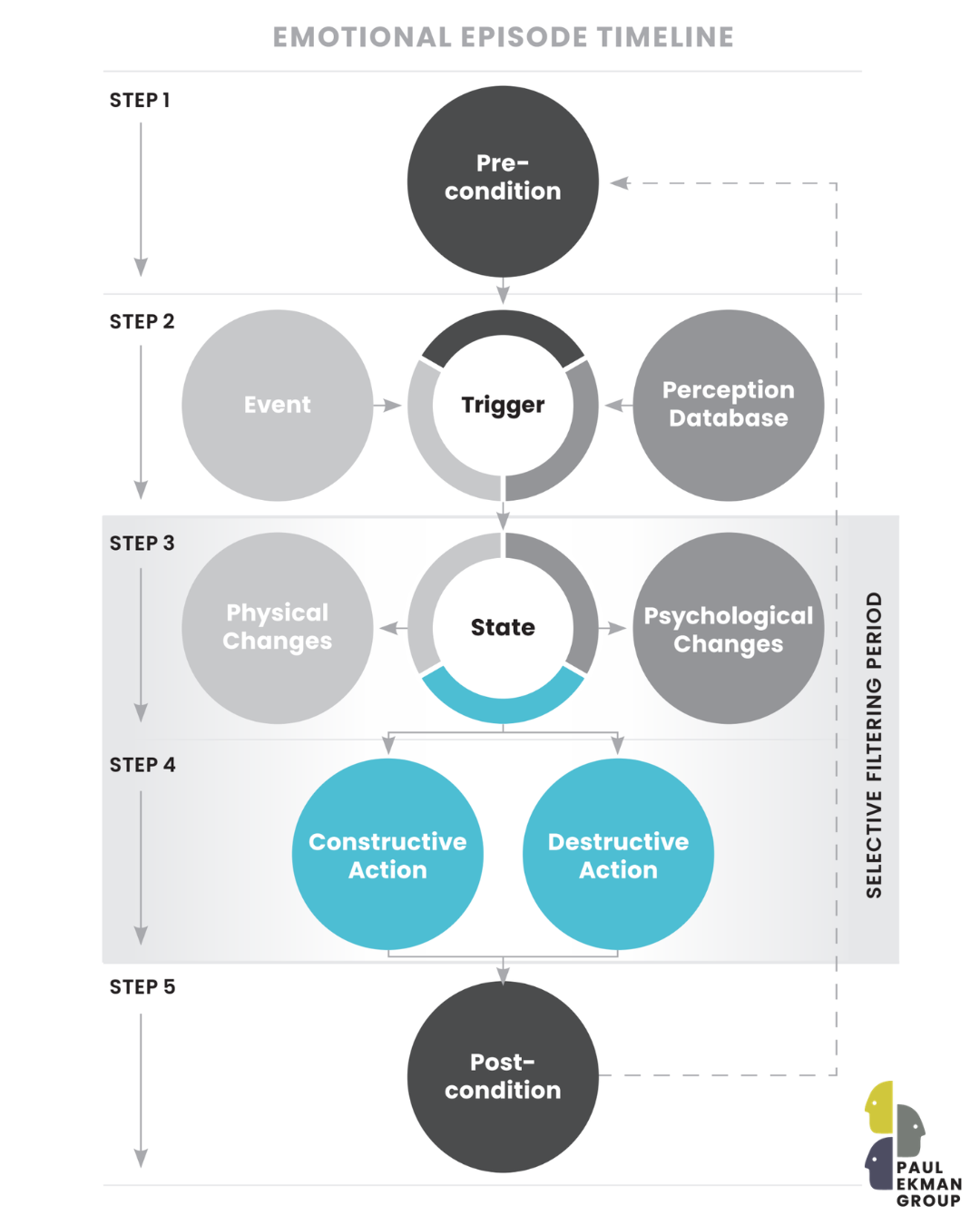
Our moods influence how readily emotions arise and how intensely we experience them. Someone in an upbeat mood may recover more quickly from frustration, while someone in an irritable mood may find themselves reacting more strongly to minor setbacks. A series of short intense emotions, like being worried or frustrated can become a prolonged post-condition, like feeling in an anxious or irritable mood.
Attitudes both shape and are shaped by our emotional lives. Imagine two people receiving the same constructive feedback. One holds an attitude about feedback as a valuable opportunity to learn and feels excited. The other holds an attitude about feedback as a personal threat and feels anxious and annoyed. The situation is the same, but their attitudes shape how they evaluate it and, in turn, the emotions they experience.
One particularly important type of attitude is our attitude toward emotions themselves. We may believe that anger is dangerous, sadness is weakness, fear should be hidden, or joy should always be shared. These evaluations often develop over years through family experiences, culture, education, and personal history. Our attitudes toward emotions influence how willing we are to notice, accept, express, or learn from them. Our attitudes also relate to the concept of ‘display rules‘, what we learn about how and to whom emotional expressions are appropriate. While certain facial expressions of emotion are universal, display rules often vary across cultures, impacting differences in expressions worldwide.
At the Paul Ekman Group, we believe emotional awareness begins with learning to observe our internal experience with greater clarity and curiosity. By recognizing our emotions, understanding the moods that influence them, and becoming aware of the attitudes that shape our interpretations, we can respond more wisely and compassionately to ourselves and others.
Developing these skills takes practice, and they can be strengthened over time. If you’d like to continue exploring the science of emotion and emotional awareness, the Paul Ekman Group offers several research-based resources:
August 21, 2026
June 8, 2026