UNIVERSAL FACIAL EXPRESSIONS
ARE FACIAL EXPRESSIONS UNIVERSAL?
Facial expressions are both universal and culture-specific. Dr. Ekman discovered strong evidence of universality* of some facial expressions of emotion as well as why expressions may appear differently across cultures.
Through continued cross-cultural studies,* Dr. Ekman noticed that many of the apparent differences in facial expressions across cultures were due to context.
To describe this phenomenon, Dr. Ekman coined the term display rules: rules we learn in the course of growing up about when, how, and to whom it is appropriate to show our emotional expressions.
UNIVERSAL FACIAL EXPRESSION QUIZ
SEVEN UNIVERSAL FACIAL EXPRESSIONS
Dr. Ekman continued to research facial expressions for more than four decades after his return from New Guinea. In order to make his research applicable to the general public he created online training tools and emotion flashcards which teach you to read and respond to emotional expressions.
*Cited Journal Articles
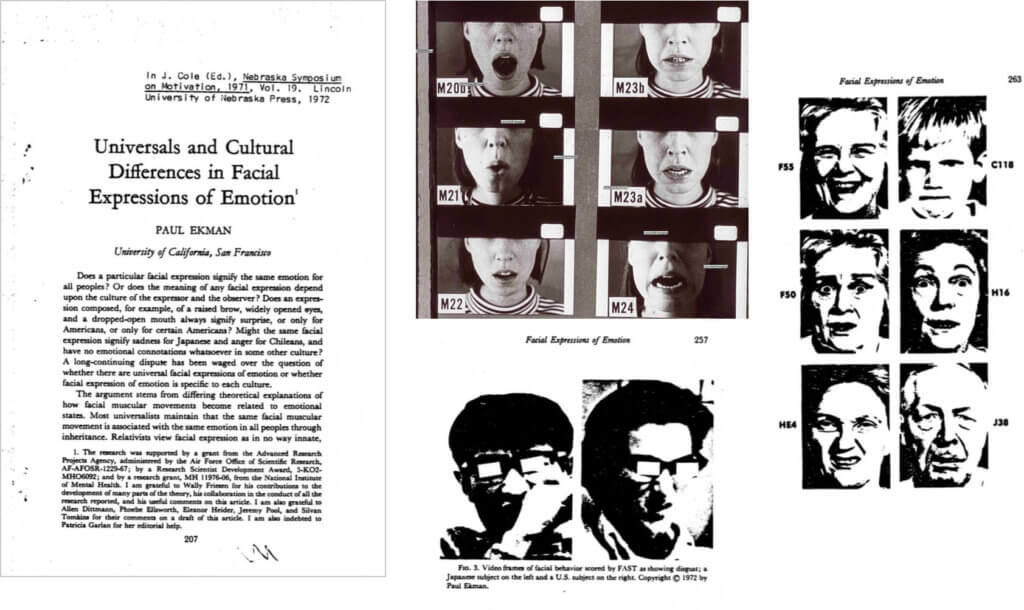
- Ekman, P. (1972). Universals and Cultural Differences in Facial Expressions of Emotions. In Cole, J. (Ed.), Nebraska Symposium on Motivation (pp. 207-282). Lincoln, NB: University of Nebraska Press.
- Ekman, P. & Friesen, W. V. (1971). Constants Across Cultures in the Face and Emotion. Journal of Personality and Social Psychology, 17(2) , 124-129.
- Ekman, P., Friesen, W. V., & Tomkins, S. S. (1971). Facial Affect Scoring Technique: A First Validity Study. Semiotica, 3, 37-58.
- Ekman, P. (1970). Universal Facial Expressions of Emotions. California Mental Health Research Digest, 8(4), 151-158.